
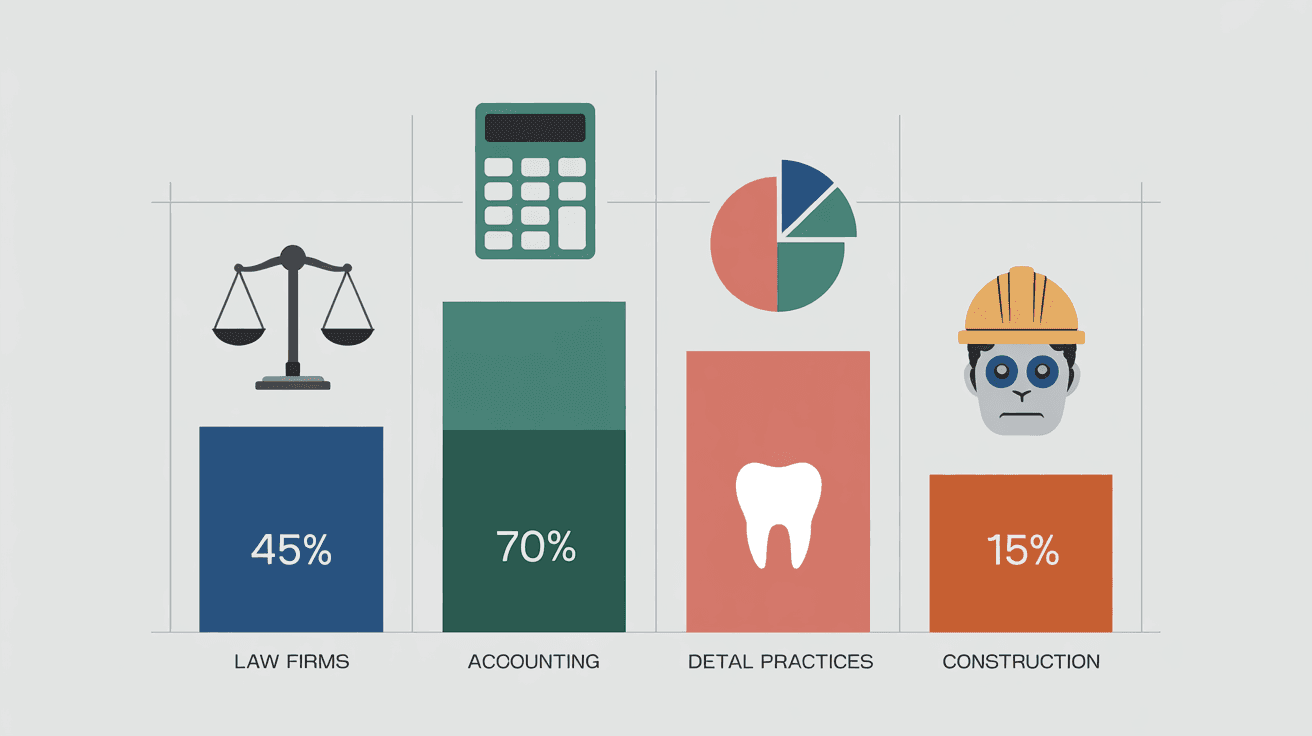
AI Adoption by the Numbers: Law Firms vs. Accounting Firms vs. Everyone Else
A data-driven comparison of AI adoption rates across law firms, accounting firms, dental practices, and construction — who's leading, who's lagging, and what it means for your firm.
There's a comfortable narrative floating around professional services: "Everyone is in the same boat with AI." It's reassuring, and it's wrong.
The data tells a completely different story. Accounting firms have seen AI adoption rates jump from 9% to 41% in a single year. Law firms are stuck at 21% firm-wide adoption despite 69% of individual lawyers using AI tools on their own. Dental practices are deploying AI diagnostics that reduce overhead by 25%. And construction — an industry most people wouldn't associate with cutting-edge technology — is pouring billions into AI with year-over-year adoption growth of 59%.
The AI adoption landscape across professional services isn't just uneven. It's a five-lane highway where some industries have hit cruising speed while others are still looking for the on-ramp. This breakdown covers what the actual data says, industry by industry, so you can see exactly where your profession stands and what the leaders in each field are doing differently.
Law Firms: Individual Enthusiasm, Institutional Hesitation
The legal profession presents one of the most striking paradoxes in AI adoption. Individual lawyers are embracing AI at record rates, but the firms they work for are barely moving.
The Personal vs. Firm-Wide Divide
According to the 2026 8AM report on legal AI adoption, 69% of legal professionals now use generative AI tools for work — more than double the rate from the previous year. That's not casual experimentation either: 28% use AI every day, and another 31% use it several times a week.
But here's the disconnect. Firm-wide AI adoption sits at just 21%, actually down slightly from 24% in 2023. That means nearly seven out of ten lawyers are using AI tools, but fewer than one in four firms have officially adopted and integrated these tools into their operations.
This gap matters enormously. When lawyers use AI without firm-level strategy, training, or governance, you get inconsistency. One partner uses Claude for contract review. Another uses Gemini for research. A third has no idea either is happening. There's no quality control, no shared learning, no measurement, and critically — no competitive advantage. It's just individual convenience.
Size Creates a Stark Divide
The divide deepens when you look at firm size. Firms with 51 or more lawyers reported a 39% AI adoption rate, while firms with 50 or fewer lawyers came in at approximately 20%. Smaller firms — the ones that arguably have the most to gain from AI-driven efficiency — are adopting at half the rate of their larger competitors.
This is partly a resource problem. Larger firms have IT departments, innovation partners, and technology budgets that smaller firms don't. But it's also a mindset problem. Small firm owners tend to see AI as a large-firm luxury rather than a small-firm equalizer. The irony is that AI tools in 2026 are more affordable and accessible than ever, and the productivity gains are proportionally larger for a five-person firm than a five-hundred-person firm.
Practice Area Variations
Not all legal specialties are moving at the same pace. Civil litigation firms lead AI adoption at 27%, which makes sense given the volume of document review and research involved in litigation. Personal injury and family law follow at 20% each. Immigration firms trail at 17%.
The pattern is predictable: practice areas with high-volume, document-intensive work adopt fastest because the ROI is most visible. A litigation firm that can process discovery documents in hours instead of days sees the value immediately. An estate planning firm dealing with fewer, more bespoke matters has a harder time seeing the payoff — even though AI tools like document assembly and client communication automation could transform their workflow just as dramatically.
Where Legal AI Is Actually Going
The Thomson Reuters 2026 report on legal AI reveals that the next frontier is agentic AI — autonomous systems that handle multi-step legal workflows. Currently, 16% of legal firms already use agentic AI, with 19% planning to adopt it. Another 30% are considering it, while 35% have no plans at all.
The 35% with no plans are making a bet — whether they realize it or not — that the legal market won't punish them for inaction. Given that Thomson Reuters estimates AI will save the legal industry a cumulative $20 billion annually in productivity gains, that's a bet with increasingly poor odds.
Accounting Firms: The Fastest Movers in Professional Services
If law firms represent cautious institutional hesitation, accounting firms represent the opposite end of the spectrum. The numbers here are staggering.
The 9% to 41% Leap
The headline number is hard to overstate: AI adoption in accounting firms jumped from 9% in 2024 to 41% in 2025, according to the Wolters Kluwer Future Ready Accountant report. That's a four-and-a-half-fold increase in a single year. No other professional services sector has seen anything close to this rate of change.
The acceleration was driven by a convergence of factors. Tax season pressure created an urgent need for efficiency. Vendor platforms like Intuit, Wolters Kluwer, and Thomson Reuters embedded AI directly into tools accountants already used, lowering the barrier to entry. And a generational shift in the profession — where staffing shortages have become chronic — made automation not just attractive but necessary.
Beyond Adoption: How Firms Are Actually Using AI
The breadth of AI usage in accounting is equally impressive. 95% of accounting firms adopted some form of automation technology in the past year, with the top use cases being payroll processing (47%), accounts payable and receivable (46%), and data entry and transaction processing (43%).
But the real story is how AI is changing the nature of the work. 93% of accountants who use AI report that they've used it to enhance strategic advisory services — things like improving client interactions, generating financial summaries, and delivering real-time insights. This is the shift from compliance to advisory that the profession has been talking about for a decade, and AI is finally making it operational.
The firms investing in AI training are seeing outsize returns. Firms that invest in AI training are unlocking an additional seven weeks of capacity per employee per year. Seven weeks. For a 10-person firm, that's the equivalent of adding 1.3 full-time employees without a single hire. In a profession plagued by a talent shortage, that math changes everything.
The Adoption Gap Problem
Despite the impressive headline numbers, accounting has its own version of the legal divide. The AICPA and CIMA's February 2026 global survey of 1,735 executives revealed a widening gap between "AI-Transformed Entities" and everyone else.
The key finding: only about 1 in 7 respondents said they had significant access to the talent and skills needed for AI integration, and about 1 in 6 had access to needed IT systems. But among AI-transformed entities, roughly 1 in 2 reported "mostly" or "extensively" having those capabilities. The gap isn't shrinking — it's accelerating.
The firms at the front of the curve are compounding their advantage through better data, better processes, and better-trained teams. The firms in the middle are adopting tools without strategy. And the firms at the back are running out of time to close the gap before it becomes a chasm.
Agentic AI: The Next Inflection Point for Accounting
Looking forward, 2026 is the year agentic AI reaches the tipping point in tax and accounting firms. AI agents — autonomous systems that can handle multi-step workflows like reconciliation, data gathering, and client communication sequences — represent a fundamental shift in how accounting work gets done.
This isn't about replacing accountants. It's about eliminating the 60-70% of the work that's process-driven and repetitive, freeing accountants to focus on the judgment-intensive advisory work that clients actually value most. The firms that deploy agentic AI effectively will be able to serve more clients, with fewer staff, at higher margins. Firms that don't will be competing on labor arbitrage — a game that gets harder every year as talent gets scarcer and more expensive.
Dental Practices: The Quiet Disruptor
Dental practices don't get the same attention as law or accounting when it comes to AI coverage, but the adoption numbers tell an interesting story. This is a profession where AI is being deployed for clinical outcomes, not just administrative efficiency — and the results are turning heads.
Diagnostic AI Is Leading the Charge
The dental AI market is growing rapidly, driven primarily by diagnostic and imaging applications. AI tools that analyze dental images — X-rays, intraoral scans, CBCT images — have become the most advanced and widely adopted category, improving diagnostic speed, consistency, and accuracy in ways that are measurable at the patient level.
Companies like Overjet and Pearl AI are leading this category. Their tools can detect cavities, periodontal disease, and other conditions in radiographs with accuracy rates that match or exceed human dentists in peer-reviewed studies. For practices, this means faster diagnosis, more consistent treatment planning, and a defensible standard of care — all of which translate into better patient outcomes and lower liability exposure.
Operational Gains Are Substantial
Beyond diagnostics, dental practices are seeing significant operational improvements from AI adoption. Automation is reducing administrative tasks by up to 25%, freeing staff to focus on patient care. In large practices, AI-driven scheduling has cut booking time by 20%.
The financial impact is equally compelling. Dental practices that have adopted AI tools for scheduling, patient communication, and treatment planning have reported 20-30% reductions in overhead and 35-50% fewer no-shows. For a practice with $1 million in revenue, a 25% overhead reduction translates directly to an additional $50,000-$75,000 in profit — before accounting for the revenue gains from fewer missed appointments.
The 2026 Shift: AI Agents Arrive in Dentistry
The Institute of Digital Dentistry identifies the major new trend for dental practices in 2026 as the adoption of AI agents — virtual coworkers that autonomously plan and execute multi-step workflows. These agents can handle everything from new patient scheduling and insurance verification to post-treatment follow-up sequences.
With 65% of dental practices considering AI adoption, the profession is approaching a tipping point. Early adopters are already gaining competitive advantage through better patient outcomes, lower costs, and higher patient satisfaction scores. Practices that wait will increasingly face a market where patients expect AI-enhanced care as the baseline, not a differentiator.
Construction: The Sleeping Giant Awakens
Construction might be the biggest surprise in the AI adoption story. An industry historically known for slow technology adoption is suddenly moving — and moving fast.
The Numbers: Complicated but Trending Up
Construction AI adoption data is messy because different surveys measure different things. At one end, the Bluebeam survey found that only 27% of architecture, engineering, and construction professionals use AI in their operations. At the other end, RSM's survey found that 94% of construction respondents said their organization uses AI tools.
The gap likely reflects the difference between "someone at the company has used ChatGPT" (94%) and "we've integrated AI into our operational workflows" (27%). The truth is probably that most construction firms have explored AI in some capacity, but relatively few have moved beyond experimentation to systematic deployment.
What's not debatable is the trajectory. OECD data shows year-over-year AI adoption growth of 59.1% in construction, one of the fastest growth rates of any industry. And investment is following: the AI-in-construction market is projected to grow from $4.86 billion in 2025 to $22.68 billion by 2032, representing a nearly five-fold increase.
Where Construction AI Is Being Applied
The use cases in construction are different from other professional services. Scheduling optimization and predictive maintenance lead the way, followed by safety monitoring, cost estimation, and quality inspection. AI-powered drones and computer vision systems that can monitor construction sites in real time — flagging safety violations, tracking progress against schedules, and detecting quality issues — are moving from pilot programs to standard practice.
For construction firm owners, the competitive dynamics mirror what's happening in other professions, but with an additional twist: construction's labor shortage is among the most severe of any industry. AI isn't just a competitive advantage — it's an operational necessity. Firms that can use AI to do more with fewer workers have a structural advantage in a market where qualified labor is the binding constraint.
The Belief-Action Gap
One striking data point: 87% of construction firms believe AI matters for their industry's future. But as the adoption numbers show, believing AI matters and actually deploying it are very different things. The RICS 2025 report found that 45% of construction organizations report no AI use at all, and just 12% say AI is used regularly in specific workflows.
This belief-action gap creates an opening for firms that move from awareness to implementation. The competitive advantage in construction isn't about having better AI tools — it's about being among the minority that actually uses them.
The Cross-Industry Comparison: What the Data Reveals
When you lay the adoption data side by side, several patterns emerge that apply regardless of your specific profession.
The Adoption Scoreboard
Here's how the industries compare on key metrics:
AI Adoption Rate (Firm-Wide):
- Accounting: 41% (up from 9% in 2024)
- Professional Services overall: 36.8% (OECD data)
- Construction: 27% (operational deployment)
- Law: 21% (slightly down from 24% in 2023)
- Dental: Growing fast, with 65% considering adoption
Year-Over-Year Growth:
- Accounting: 355% increase (9% → 41%)
- Construction: 59.1% growth (OECD)
- Legal: 86% growth in individual use (but flat/declining at firm level)
- Dental: Market growing rapidly, specific rates emerging
Agentic AI Readiness:
- Accounting: At tipping point, vendors integrating agents into existing platforms
- Legal: 16% using, 19% planning, 35% no plans
- Dental: Emerging, with AI agents for scheduling and workflow automation
- Construction: Early stage, focused on site monitoring and project management
Pattern 1: The Tools-Before-Strategy Trap
Across every industry, the same pattern repeats. Individual professionals adopt AI tools for personal productivity. Firms either ignore it or count it as "adoption." But without a firm-level strategy, the benefits don't compound and the competitive advantage doesn't materialize.
This is what the Thomson Reuters research meant by the "3-4x" multiplier. It's not that firms with strategies have better tools. They have better deployment, measurement, and iteration. The tools are the same — the approach is what's different.
Pattern 2: Size Isn't Destiny, but It's a Factor
Larger firms adopt faster across every industry. 52% of large firms use AI versus 17.4% of small firms, according to OECD data. In law, firms with 51+ lawyers adopt at nearly double the rate of smaller firms.
But size-based advantages are temporary. Small firms that adopt AI strategically can punch above their weight because the proportional impact is larger. A solo CPA who automates seven weeks of administrative work gains a larger percentage of capacity than a 500-person firm that does the same. The question isn't whether small firms can compete on AI — it's whether they will.
Pattern 3: The Training Gap Is Universal
Only 34% of organizations are actively reskilling employees for AI tools (McKinsey). In accounting, only 37% of firms invest in AI training despite 85% of professionals being excited about AI. In law, firm-wide training programs remain rare outside of the AmLaw 200.
The firms that close this gap first get a double benefit: their existing team becomes more productive, and they become more attractive to talent that wants to work with modern tools. In a market where every profession is facing staffing challenges, the ability to attract and retain AI-literate professionals is itself a competitive advantage.
Pattern 4: The Vendor Effect
Accounting's rapid adoption wasn't just organic enthusiasm — it was vendor-driven. When Intuit, Wolters Kluwer, and Thomson Reuters embedded AI features directly into the platforms accountants already used, adoption followed naturally. Accountants didn't have to seek out AI tools; the tools came to them.
Legal technology is following the same path, just 12-18 months behind. Clio, Westlaw, and LexisNexis are all building AI capabilities into their core platforms. When this embedded AI reaches the same maturity as accounting's embedded tools, expect legal adoption to accelerate significantly.
For dental and construction, the vendor ecosystem is less consolidated, which means adoption requires more deliberate effort from individual practices and firms. This is both a barrier and an opportunity: the firms that invest now, before AI is embedded in standard tools, get a head start that will compound.
What This Means for Your Firm
Regardless of your industry, the data points to three actionable conclusions.
First, benchmark yourself against your specific industry, not professional services as a whole. If you're a law firm at 21% adoption, you're average for your industry but significantly behind accounting. If you're a dental practice that hasn't started, you're in the majority — but that majority is shrinking fast. Know where you stand relative to your direct competitors, not the general market.
Second, the window for early-mover advantage is closing, but it hasn't closed. Even in accounting, the fastest-moving profession, only 41% of firms have adopted AI. In every other profession, the number is lower. There is still a first-mover advantage available to firms that get strategic about AI now. But "now" matters. The data shows that early adopters are compounding their advantages through better data, trained teams, and refined workflows — and that advantage becomes harder to replicate with each passing quarter.
Third, strategy beats tools every time. The accounting profession's 9%-to-41% leap wasn't driven by any single AI tool. It was driven by the convergence of vendor integration, business pressure, and firms that made intentional decisions about where and how to deploy AI. That strategic approach — mapping AI to high-value workflows, investing in training, and measuring results — works in every profession. The firms that adopt it will lead their industries, regardless of where their industry's adoption rate stands today.
The numbers are in. The question isn't which industry is "winning" at AI — it's whether your firm is keeping pace with the leaders in yours.
Subscribe to the Briefing
Continue accelerating your intelligence with unfiltered ROI tracking, tool benchmarks, and architectural implementation drops.