AI for Dental Practices: The Tools That Are Actually Reducing Overhead by 20-30%
Dental practices are discovering that AI isn't a luxury—it's the fastest way to cut administrative overhead while improving patient care. Here's what's actually working.
Dental practice owners are facing a squeeze that most industries have faced in reverse: the cost of hiring and retaining administrative staff is accelerating faster than revenue growth.
The typical dental practice spends 25-35% of revenue on administrative overhead: scheduling appointments, managing insurance claims, patient communication, billing, filing, staff coordination. That's not incompetence. That's just how dental practices work.
AI is changing that. And unlike most AI use cases in professional services, AI for dental practices delivers ROI fast. Practices are reporting 20-30% reductions in administrative overhead by implementing the right tools.
Here's what's working.
The AI Opportunity in Dental Practices
Dental practices differ from law and accounting in important ways. Your revenue is dependent on:
- High touch scheduling – Getting the right patient in the right chair at the right time
- Insurance management – Processing claims, verifying coverage, coordinating benefits
- Patient communication – Reminders, confirmations, post-visit follow-up
- Clinical documentation – Notes, treatment plans, progress records
- Billing and collections – Getting paid for services rendered
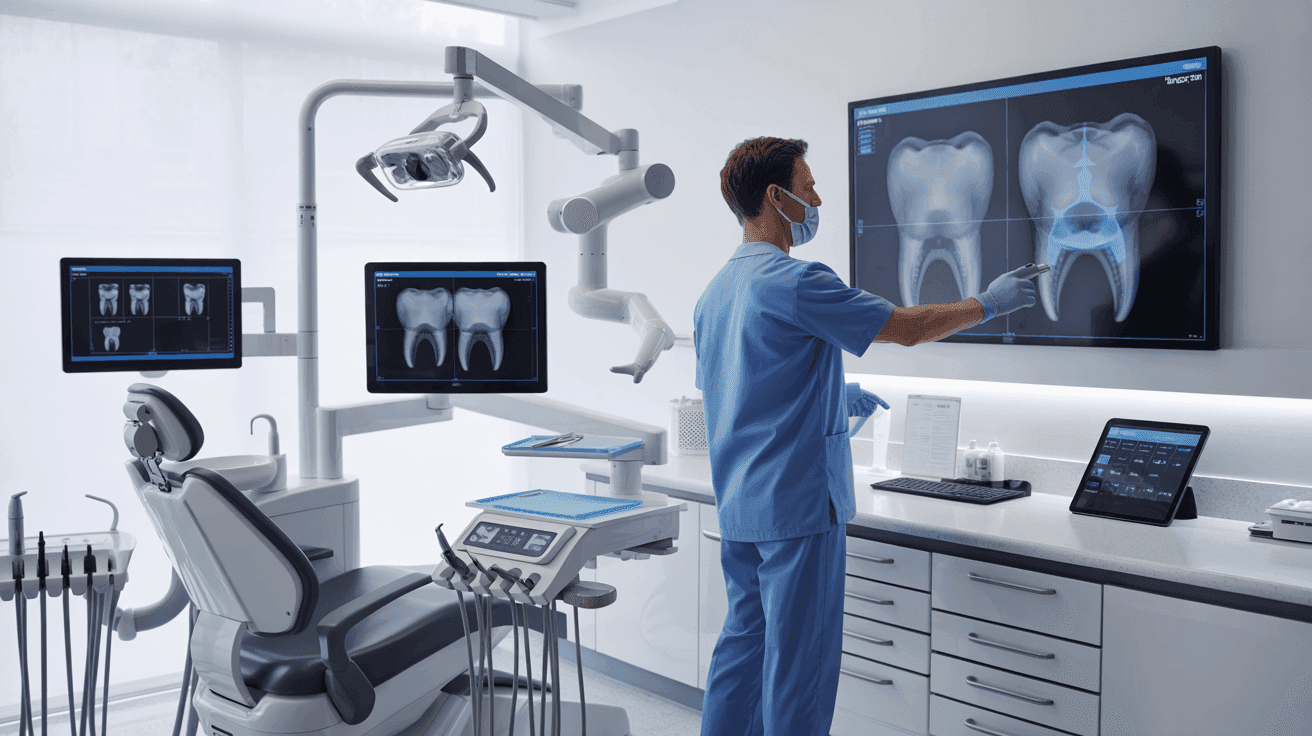
Administrative work dominates dentistry more than most other professional practices. A typical dental hygienist or assistant spends 40%+ of their time on non-clinical work: checking in patients, collecting insurance info, entering notes, updating records.
AI targets exactly that 40%. Cut that in half and you've freed up hours per day that can be redirected to patient care or practice expansion.
The Tools Actually Being Deployed
For Appointment Scheduling and Patient Communication
Acuity (Squarespace Acuity)
Scheduling software with AI-powered patient communication and confirmation reminders. Automatically sends appointment reminders, handles cancellations and rescheduling through text/email, and flags high-risk no-shows.
Impact: Reduces no-show rates by 20-30% and eliminates manual reminder work. For a practice with 50 appointments per week, that's 3-4 hours saved per week on scheduling and communication.
Cost: $15-$50/month
Google Calendar + AI Assistant (Using GPT/Claude)
Some practices are training AI assistants on their calendar data to handle appointment requests, manage scheduling, and coordinate with patients via email and text.
Impact: Custom but typically saves 2-3 hours per week on scheduling.
Cost: Free (if using personal OpenAI account) or $15-$20/month
For Clinical Documentation
Dentistry software with AI transcription (Curve, Dentrix, Open Dental)
Dental practice management software is increasingly embedding speech-to-text AI that lets hygienists and dentists dictate notes instead of typing them. The AI transcribes in real time and the clinician reviews/edits.
Impact: Cuts documentation time from 8-10 minutes per patient to 2-3 minutes. For a hygienist seeing 10 patients per day, that's an hour saved daily.
Cost: Built into modern practice management software ($200-$500/month for full practice)
Nabla or Fathom (Specialized Dental Dictation)
AI-powered clinical documentation specifically trained on dental terminology and workflows. Dentist or hygienist dictates findings, and the AI generates structured clinical notes.
Impact: Similar to above—reduces documentation time by 60-70%.
Cost: $50-$150/month depending on usage
For Insurance and Billing
Toothwise (AI Claims Coordinator)
AI that reviews insurance claims, flags issues that will likely result in denials, and coordinates follow-up with insurance companies.
Impact: Reduces claim denials by 15-25% (typically worth $2,000-$5,000/month for a mid-size practice) and eliminates manual claim review work.
Cost: $200-$500/month
Built-in AI in Modern Practice Management Software
Dentix, Curve, and other newer practice management platforms are embedding AI claims verification and processing into their core offering. These tools flag missing information before claims are submitted.
Impact: Similar to Toothwise—reduces denials and claim processing time.
Cost: Included in practice management software
For Patient Communication and Engagement
Lighthouse (Patient Communication Platform)
AI-driven patient messaging that handles appointment confirmations, post-visit follow-up, and treatment plan communication automatically.
Impact: Reduces patient communication staff time by 30-50% and improves patient satisfaction through faster response times.
Cost: $200-$500/month
Chatbots for Patient Intake
AI-powered chatbots that handle the first interaction with a new patient. Collects information, answers common questions, and gathers preliminary health history before the patient talks to a human.
Impact: Reduces front desk intake time from 10-15 minutes per new patient to 2-3 minutes and improves quality of information collected.
Cost: $100-$300/month depending on volume
The Implementation Playbook
Implementing AI in a dental practice is different from law or accounting because it directly impacts clinical workflows. Here's how to do it without disrupting care:
Phase 1: Administrative Automation (Weeks 1-4)
Start with pure administrative work: scheduling reminders, insurance verification, patient communication.
Tools to deploy: Acuity for scheduling, AI chatbot for intake
Expected impact: 3-5 hours per week saved on administrative work
Implementation approach: Start with new patient intake (chatbot) first. That doesn't impact existing workflows. Then layer on appointment reminders.
Phase 2: Clinical Documentation (Weeks 5-8)
Once administrative work is automated, tackle documentation. This is where the biggest hours are saved.
Tools to deploy: Dental AI dictation (Nabla, Fathom, or built-in to practice management software)
Expected impact: 1-2 hours per day saved on documentation per clinician
Implementation approach: Train one clinician thoroughly, use them as a champion. Let them use it for 2 weeks, work out the kinks, then roll out to the rest of the clinical team.
Phase 3: Claims Processing (Weeks 9-12)
Once documentation is streamlined, add claims processing automation.
Tools to deploy: AI claims verifier (Toothwise or built-in)
Expected impact: 15-25% reduction in claim denials, 2-3 hours per week saved on claims follow-up
Implementation approach: This can be deployed practice-wide immediately. It's a pure back-office function.
The ROI Calculation
For a typical 5-operatory dental practice (5 hygienists + 2 dentists + 3 administrative staff):
Current administrative overhead: $180K-$250K/year (3 FTE at $60-80K loaded cost)
AI implementation cost: $3,000-$6,000/year (various tools)
Freed-up time: 15-20 hours per week across the practice
What you do with freed-up time:
- Option 1: Reduce administrative staff by 1 person (saves $70K/year)
- Option 2: Keep the same headcount but expand practice (add 10-15% more patient capacity without hiring)
- Option 3: Hybrid (reduce admin staff by 0.5 FTE, expand practice by 5-7%)
Net ROI: $50K-$70K/year in either cost savings or incremental revenue
That's $4,000-$6,000/month ROI on a $300-$500/month tool investment. That's not a marginal improvement. That's a structural change to the economics of the practice.
The Pitfalls to Avoid
Pitfall 1: Deploying Without Clinical Buy-In
Dentists and hygienists can make or break AI implementation. If they don't trust the tool or don't see how it helps them, they'll work around it. Get their input before selecting tools.
Pitfall 2: Trying to Replace Clinical Judgment
AI in dentistry should augment clinical decision-making, not replace it. Diagnostic AI should flag interesting cases and improve accuracy. It shouldn't be the only thing informing diagnosis.
Pitfall 3: Poor Data Quality
AI is only as good as the data it gets. If your practice management software has incomplete records, outdated insurance info, or inconsistent note formatting, AI tools will struggle. Clean up your data first.
Pitfall 4: Deploying Too Much Too Fast
Don't implement five tools simultaneously. Start with scheduling/communication. Get that working. Then add documentation. The phased approach prevents overwhelm and gives you time to measure what's actually working.
What to Look for in Tools
When evaluating tools for your practice:
-
Does it integrate with my practice management software? Tools that feed data in and out automatically are 10x more valuable than tools that live in isolation.
-
Is it HIPAA compliant? Non-negotiable. Any tool handling patient data must meet HIPAA standards.
-
Will my clinical team use it? Get feedback from at least one dentist/hygienist before committing. If they won't use it, the tool is worthless.
-
What's the real cost? Factor in training time, integration time, and ongoing support, not just monthly fees.
-
Is there community and support? Newer tools with small communities can be risky. You need a vendor that can help when things go wrong.
The Future of AI in Dental Practices
Dental practices are at an interesting inflection point. AI is mature enough to deliver real value today. Yet many practices haven't adopted any AI yet, meaning there's a significant competitive advantage for early movers.
A practice that implements scheduling automation, clinical documentation AI, and claims processing AI today will operate with fundamentally different economics than a practice that doesn't. They'll have lower overhead, faster throughput, and happier clinicians doing less busywork.
For dental practice owners looking to improve margins without cutting services, AI isn't optional anymore. It's the fastest path to a healthier business.
Subscribe to the Briefing
Continue accelerating your intelligence with unfiltered ROI tracking, tool benchmarks, and architectural implementation drops.